by Betsy Franjola
April 7, 2026
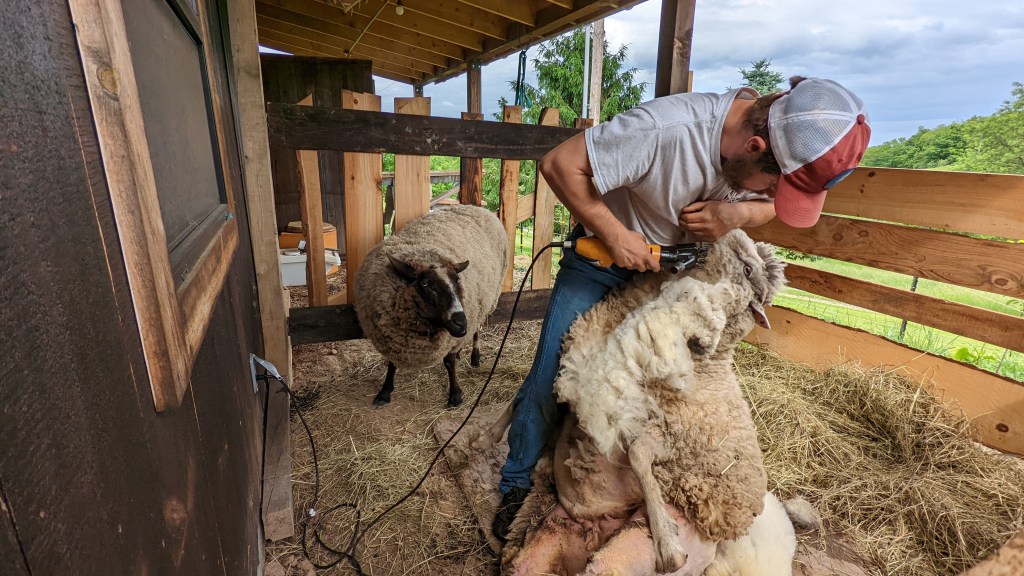
Today, many sheep farmers in our region don’t raise sheep for wool, and some hesitate to raise sheep at all because they have been told that fleece holds little to no market value. Shearing, which is necessary for animal health, often costs more than the perceived value of wool. To make matters harder, Southeast Ohio no longer has enough trained shearers, so farmers must bring in specialists from other parts of the state or even across state lines just to complete the job.
And yet, walk into a clothing store and pick up a wool sweater. The price tag tells a very different story.
Somewhere between pasture and product, value is being created, but it’s not staying with the farmer, and it’s not staying in our region. That gap is the result of a missing system. For generations, the United States, and especially rural regions like central Appalachia, lost the local infrastructure that once connected growers to mills, mills to makers, and makers to markets. When those links disappeared, so did regional fiber economies.
Our Southeast Ohio Fibershed affiliate, originally organized in 2021 and relaunched January 1, 2026, exists to rebuild connections between agriculture and industry. We are working to reconnect farmers raising sheep, alpaca, and other fiber animals—and eventually growers of hemp, flax, cotton, and natural dye plants—with the people and places that can transform raw fiber into finished textiles.
This is not nostalgia. It’s economic development, climate resilience, and community building woven together.
We are encouraged by some of the first threads that are already in place.
Southeast Ohio Fiberworks has offered hand-dyed wool roving and yarn, both local and imported, to supply regional fiber artists since 2020.
The Hocking Hills Garment Center, operating in Athens County for just over a year, is already producing apparel for startup, regional, and nationally recognized brands.
Equipment for a regional dye house has been secured, and once a facility is finalized, we will establish a garment dye operation capable of both conventional and natural dye processes—with future expansion into yarn and fabric dyeing.
But to truly restore value to wool at the farm level, we must continue rebuilding the missing middle of the supply chain. A new regional wool growers association, to replace the now-closed Mid-States Wool Co-op, could aggregate and grade fleeces. A fiber mill could wash, card, and prepare fiber. A spinner could produce high-quality yarn. Knitting and weaving partners could turn that yarn into fabric. Each step adds value. Each step creates skilled local jobs. And each step keeps dollars circulating within our communities instead of sending them elsewhere.
Imagine if shearing day became profitable again. Imagine if young people in our region could
train as shearers, mill operators, dyers, and textile technicians. Imagine if a sweater grown, processed, dyed, knit, and sold in Southeast Ohio carried not just a label—but a local story.
That future is possible, and here in Southeast Ohio, we’ve already begun spinning the first
threads.
 Southeast Ohio Fibershed
Leave a comment